

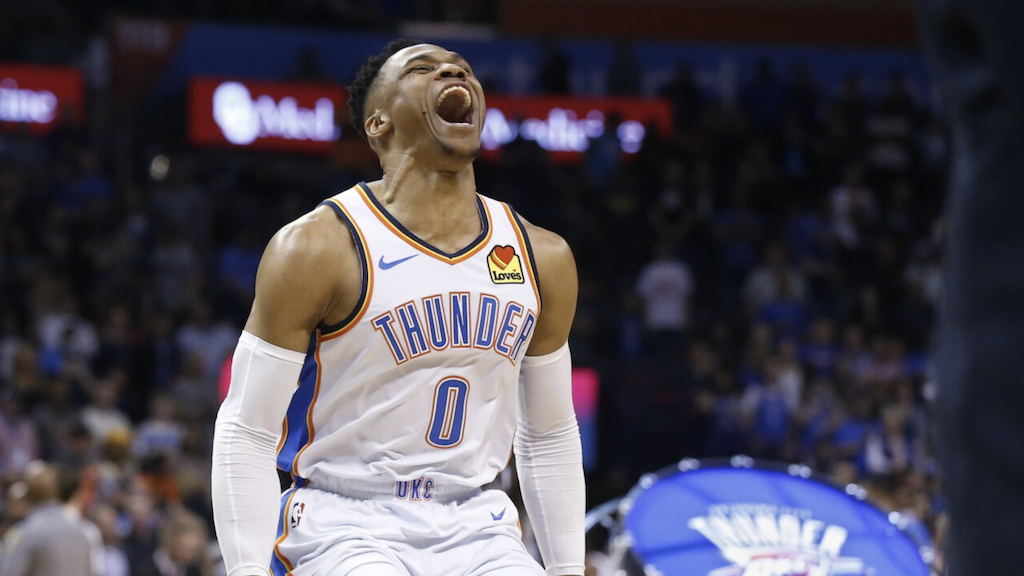
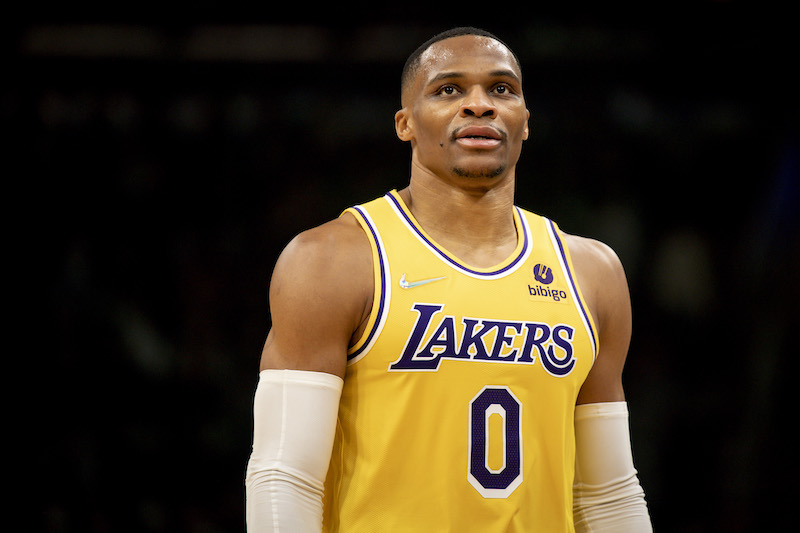
Russell Westbrook deserved better. For 18 seasons, Westbrook never cheated the game. He played every game as if it was his last. And yet, he was heavily criticized by fans and the media.
Westbrook, 37, announced his retirement on social media in a video narrated by Oscar-winning actor Michael B. Jordan.
Westbrook may not have won an NBA championship ring, but he will be remembered as one of the most electric and inspirational players of our generation. At the end of the day, what defined his basketball career was his effort and energy. He played the game at 100 mph. Sometimes he played too fast.
His candle was always lit. He didn’t need to flip a switch because his switch was always on. He was a human power generator, pumping energy into an arena. He was highly entertaining. As a fan, that’s all we ask of our athletes. Compete at the highest level and provide moments of joy. Russ was a one-man show.
Was he flawed? Sure he was. Did he turn the ball over too many times? Sure he did. Did he take too many ill-advised shots? Sure he did.
But you cannot question his heart, his toughness, and his competitiveness.
Westbrook finished his NBA career as a two-time league scoring champion and led the league in assists three times. He was a nine-time All-Star, a two-time All-Star Game MVP, and the MVP in 2017. He retires as the NBA’s all-time leader in triple-doubles. For someone who supposedly couldn’t shoot and was tagged as a ball hog, Westbrook scored 27,000 points and more than 10,000 assists, placing him in an extremely small historical group.
Russ was one of the most athletically gifted players to play in the NBA. He put together a historic 2016-17 season when he became the first player since Oscar Robertson to average a triple-double for an entire season. He set a record with 42 triple-doubles, one more than Robertson’s old mark set in 1962.
During his MVP season in 2017, Westbrook averaged 31.6 points per game, 10.7 rebounds, and 10.4 assists. He carried the undermanned Oklahoma City Thunder into the playoffs as a sixth seed in the ultra-competitive Western Conference, a year after Kevin Durant left OKC to join the Golden State Warriors.
Durant had a complicated relationship with Westbrook, but the two patched things up and KD posted a touching tribute on social media following Westbrook’s retirement, highlighting his former OKC teammate’s leadership style and his impact on the court.
“He led by example, and once the lights were bright, he let everything out and experienced pure freedom,” Durant said. “It was inspiring as his teammate, and everywhere I went, I saw it inspire people from all walks of life. The crazy thing is, he didn’t say much, he just showed up.”
Westbrook definitely showed up and showed out. You might knock him down a few times, but he kept coming.
In a 2015 game against the Portland Blazers, Westbrook got kneed in the head by a teammate and fractured his cheekbone. He stayed in the game with a visible dent and finished with 40 points, 13 rebounds, and 11 assists. Brodie had surgery and missed one game. In his next game, wearing a protective mask, he dropped 49 points, grabbed 15 rebounds, and had 10 assists.
Westbrook had as many detractors as admirers. Westbrook joked that “Spalding” was his best friend. Westbrook rubbed people the wrong way with his abrasive personality. But what drove a lot of basketball pundits completely batty was Westbrook’s shot selection and recklessness.
In his short stint with the L.A. Lakers, he was reportedly called a “vampire” for sucking the life out of the team. He got blamed for everything that went wrong. Many Lakers fans pinned losses on him.
“If you don’t respect and admire Russell Westbrook, there’s something wrong with you,” Charles Barkley said. “I’ve never seen a player give maximum effort every single night.”
Here’s a question Lakers fans who dissed Russ: how can you hate on a guy who grew up idolizing the Lakers. He attended Leuzinger High School in Lawndale. He went to UCLA and made two Final Four appearances. He represented L.A. He never forgot his L.A. roots. If he was such a bad guy, then why do all his teammates love him? You’d be hard-pressed to find a Westbrook teammate who didn’t like him.
Lakers guard Austin Reaves was one of countless Westbrook teammates who had nothing but love for him. Reaves, who was then a role player with the Lakers, recalled getting COVID during a road trip and was forced to isolate in a hotel room for a few days. Reaves said it was Westbrook who checked on him and asked him if he needed anything.
That was Russ. A good guy and a great teammate.
***
Since 1956, when the first NBA regular season MVP award was handed out, six most valuable players finished their careers without winning a championship and two are still in pursuit of that elusive chip.
Twelve of the 15 players with multiple MVPs led their teams to at least one NBA championship. The only three multiple MVP winners — Karl Malone, Steve Nash — don’t have a championship. Malone reached the NBA Finals twice, but lost each time to Jordan’s Chicago Bulls. Nash never made it to the NBA Finals.
Here are the ringless NBA MVPs: Charles Barkley (1993), Malone (1997, 1999), Allen Iverson (2001), Steve Nash (2005, 2006), Derrick Rose (2011), Russell Westbrook (2017), James Harden (2018), Joel Embiid (2023).
Charles Barkley (1993 MVP)
Barkley is one of the most beloved sports figures of all-time. He had a big personality to match his big physical presence on the court. He was drafted by the Philadelphia 76ers in 1984 and quickly became a fan favorite in Philly. After being traded to Phoenix in 1992, Barkley enjoyed his best season as he captured the 1993 MVP and led the high-powered Suns to the best record in the league and advanced to the NBA Finals. But Barkley’s Suns ended up losing to Michael Jordan’s Bulls in the ’93 Finals, and Barkley never got back to The Finals. He did manage to win two Olympic gold medals, and his career was validated by being selected to the 1992 Dream Team. The Round Mound of Rebound finished with more than 23,000 points and 12,000 rebounds. He was a unique player who wasn’t defined by one position. Barkley has said many times publicly that not winning a title shouldn’t and didn’t define his basketball career. Hard to argue with Sir Charles.
Karl Malone (1997, 1999 MVP)
The Mailman finished his career as the second-leading scorer in history (36,928). He made the All-NBA first team 11 times and made the All-Defensive team three times. He was named to the NBA’s top 50 greatest players list and widely regarded as one of the best power forwards. With the help of longtime teammate and fellow Hall of Famer John Stockton, The Mailman delivered two MVPs as a member of the Utah Jazz but couldn’t deliver a title to Salt Lake City. Malone led the Jazz to appearances in the NBA Finals in 1997 and 1998. Both times his teams lost to Michael Jordan’s Bulls in six games. In 2003-04 Malone joined Kobe Bryant and Shaquille O’Neal in L.A., hoping to make one final push for a ring. But it wasn’t meant to be, as Malone had an injury-plagued season and the Lakers went down to the Detroit Pistons in five games in The Finals.
Allen Iverson (2001 MVP)
Much like Westbrook, Iverson was a fearless competitor who played with reckless abandon. A.I. answered the call several times throughout his 13-year career, putting together an MVP season in 2001 and leading the Sixers to the NBA Finals. But Iverson ran into Goliath in the form of Shaq and the Lakers, and the Sixers were defeated in five games. That was the closest A.I. got to playing for a title. After stints in Detroit, Denver and Memphis (extremely short stint there), Iverson rejoined the Sixers but did not finish the season. He took his talents to Turkey, but that lasted about as long as A.I.’s career as a hip-hop artist. Iverson desperately wanted to finish his career in the NBA, but no team took the bait. Iverson will go down in history as a polarizing figure who gave us great highlights and one memorable soundbite. Yes, we’re talking about practice!
Steve Nash (2005, 2006 MVP)
Nash helped revolutionize the game with how he manipulated the pick-and-roll. Point guards today use the “Nash dribble” coming off picks. He reached the conference finals four times but fell short each time — three times with the Phoenix Suns and once with the Dallas Mavericks. He teamed up with Dirk Nowitzki to lead the Mavs to the 2003 Western Conference finals, losing to eventual champion San Antonio. He captured his first regular-season MVP in 2005, leading the Suns to the NBA’s best record. But the Spurs got in the way again, bouncing Nash and a loaded Suns squad that also featured Amare Stoudemire, Shawn Marion, and Joe Johnson in five games. Nash won his second MVP award in 2006, but was eliminated by Dirk’s Mavs. MVP voters may have made a mistake by giving Nash the MVP in 2006. Nash probably didn’t deserve to win it over Kobe Bryant, who had one of the best statistical seasons and delivered the signature moment of the year when he scored 81 points against Toronto. Nash maxed out in Phoenix and was never able to recapture that magic he had with coach Mike D’Antoni.
Derrick Rose (2011 MVP)
Rose’s once promising career was derailed by injuries. D-Rose was bitten by the injury bug several times and was never the same. We’ll never know how good Rose could have been had he not gotten hurt. During his time in Chicago, Rose’s Bulls teams had a nice nucleus and were strong title contenders. One year after becoming the youngest MVP in league history, a devastating ACL injury in the 2012 playoffs dramatically cut down Rose’s game. Despite flashes of his old self, Rose never returned to his MVP form. He lost the burst that made him such a tough cover, and his jump shot never got good enough to keep defenses from sagging back. All the physical gifts that made him special were no longer there. Rose bounced around the league for the next eight years, playing in New York, Cleveland, Minnesota, Detroit, and Memphis before retiring in 2024 at age 35.
James Harden (2018 MVP)
Harden came into his own when he arrived in Houston after leaving Oklahoma City. Harden went from a 17-point scorer to a 27-point scorer. He went from Sixth Man to MVP. His 2017-18 season was almost like a video game. He led the league in scoring (30.4) and was the runaway leader in free throw attempts and free throws made. No one draws fouls (or tricks referees) better than Harden. In fact, he does it so well, and so often, league officials changed the way they call games. He gets to the line 11 times a game. For an 87% free-throw shooter, that’s 10 points in the bank. Harden is so clever and crafty that he has referees completely fooled. Harden does have other skills aside from gimmicks and tricks. He has a dependable step-back jumper to create space for his 3-ball, and he had straight-line drives going to his strong hand. Once the NBA cracked down on non-basketball moves to bait referees into calling fouls, Harden’s numbers have significantly dipped.
Joel Embiid (2023 MVP)
Embiid, who had long lobbied for the award, earned his first NBA MVP trophy in 2023, beating out Denver Nuggets center Nikola Jokic. Embiid has been through the wringer in terms of working through various injuries, and his durability has been questioned. He pieced together a healthy season for the Philadelphia 76ers in 2022-23 as he averaged 33.1 points to win his second straight scoring title, 10.2 rebounds and tied a career high with 4.2 assists per game. “It’s been a long time coming. A lot of hard work. I’ve been through a lot. I’m not just talking about basketball. I’m talking about my life. My story. Where I come from. How I got here and what it took for me to be here,” said the big man from Cameroon. He’s the second winner from Africa, joining Hakeem Olajuwon, the Nigerian who won for Houston in 1994.
Joel Huerto is editor and publisher of OneManFastBreak.net. He hosts a sports podcast on YouTube @onemanfastbreak1.