

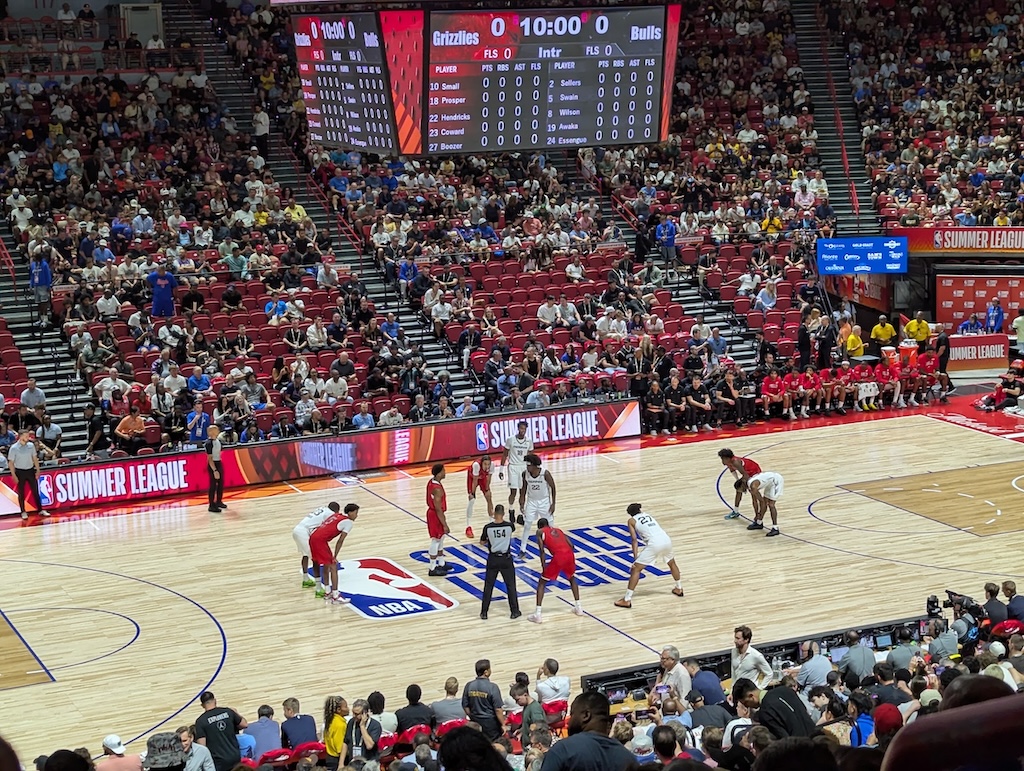
Caleb Wilson was the last one among the top-four picks in the NBA draft to make his summer league debut, and boy, oh, boy was it worth the wait.
The No. 4 overall pick in the 2026 NBA draft lit up the Las Vegas Strip with a 35-point performance against the Memphis Grizzlies. The Chicago Bulls’ 20-year-old budding superstar followed up his sensational debut with 19 points, eight rebounds, and five blocked shots against the Utah Jazz, and another 19-point, eight-rebound outing against the Washington Wizards. He capped off his Vegas one-man show with 21 points and eight rebounds against the L.A. Lakers.
Wilson was named to the all-summer league first team, along with fellow rookies Cameron Boozer (Memphis Grizzlies), Brayden Burries (Milwaukee Bucks), Maleek Thomas (Cleveland Cavaliers), and Yaxel Lindeborg (Golden State Warriors).
The Bulls fanbase hasn’t felt this good since Derrick Rose’s MVP season in 2011. Many of them came out to Thomas & Mack Arena to watch Wilson, and they certainly liked what they witnessed.
The uber-athletic 6-10 forward averaged 23.5 points, 7.5 rebounds, 1.3 steals, and 2.5 blocks. He shot 50% from the field, including a stunning 41.9% from behind the 3-point line. The 3-ball was supposed to be Wilson’s Achilles’ heel. He clearly worked on his long-range shooting in the months leading up to the summer season. He worked with renowned shooting coach Chris “Lethal Shooter” Matthews, and the extra reps definitely paid off.
About the only thing that went wrong for Wilson was his free throws. He would have had a higher scoring average if he made more free throws. But that was the only blemish in an otherwise impressive summer league for the former North Carolina Tar Heel.
Individual scoring stats were a bit inflated because of the new summer league rules in which one free throw was worth two points, and if a player were fouled behind the 3-point line, one free throw would be worth three points. The new free-throw rule — which was enforced until the last two minutes of a game — was adopted to speed up the game and improve game flow.
Wilson has drawn comparisons to NBA Hall of Famer Kevin Garnett for his two-way ability and defensive intensity. But the more we see Wilson’s game, from the way he handles the ball to get to his spots and the way he shoots his picture-perfect jumper, he reminds us of Kobe Bryant. Caleb is the latest in the long list of ballers who subscribe to the Mamba Mentality.
“We have some similarities, but I feel like we’re much different players,” Wilson said about the KG comparison. “Kevin Garnett’s a Hall of Famer. I don’t want to be compared to a Hall of Famer because that messes up my expectations.”
Unlike the Big Ticket, who relied heavily on post-ups and face-up mid-post moves, Wilson operates more like a big perimeter wing. Just like Kobe, Wilson has a tight handle. Just like Kobe, Wilson creates most of his shots off the bounce. More than anything, Wilson plays with an edge. Just like Kobe.
Check out this move by Wilson against the Grizzlies. Watch how he navigates around defenders to get to his spot for a 3-ball to beat the buzzer. He walks off the court dejected despite hitting a spectacular shot. The fact that he wears No. 8 seals it.
Future Hall of Famer and current Golden State Warrior Draymond Green thinks KG is Wilson’s baseline instead of his ceiling.
“Caleb Wilson is so good, and I think he’s still clumsy,” Green said on his podcast “The Draymond Green Show.”
“I think he’s so clumsy that he can’t really walk and chew gum at the same time. And yet, he’s already that good right now,” Green continued. “So, if that guy is still clumsy and he’s that good right now, man, what happens if he continues to grow into his body and he ain’t clumsy no more?
“I actually think Kevin Garnett could be his floor. That’s how special I think Caleb Wilson is,” Green concluded.
While top picks AJ Dybantsa and Darryn Peterson shut it down after two games in Vegas, Wilson pulled a Kobe-esque move by running through the tape while some of his peers were making a rest stop.
“I wanted to win a game before I stop,” Wilson said to reporters after the Bulls’ victory over the Dybantsa-less Wizards. “I don’t get to play again until October, probably, or whenever the season starts. I’m just trying to learn as much as I can, and there’s no better place to do that than Summer League.”
When asked about Peterson and Dybantsa skipping a showdown with him and the Bulls, Wilson said that he’s “different from all of them.’’
“I can’t say they don’t enjoy basketball, but I enjoy basketball,’’ he said. ‘‘I love this [expletive]. I’m going to play as much as I can, as much as my team will let me. I’m not the type to go away from a game because I don’t feel good because I know in the NBA, I’m not going to feel good some games. As long as I don’t have an injury or something wrong with me, I’m gonna play every time. People come from all over the world to see me play, so I don’t want to let them down.”
The Bulls have been searching for someone worthy of wearing Jordan’s sneakers. He wore Jordan Brand in college. Now he’ll be playing his home games at the house Jordan built.
Winning is what Cam does best
Cameron Boozer was the most consistent player throughout the summer. He was rock solid at the Salt Lake City Summer League, and he was outstanding at the Las Vegas Summer League. He made impactful plays. He did what was required for his team to succeed. That’s always been his best asset. He finds a way to win. He won at the high school level. He won a gold medal as a member of Team USA at the FIBA U17. He won at the AAU level. He led Duke to the Elite Eight.
Now, as a pro, he led the Memphis Grizzlies to the championship game of the Las Vegas Summer League. The Grizzlies ran their offense through Boozer in the fourth quarter. And Boozer got better as the stakes got higher.
Boozer recorded 19 points (7-for-17 from the field, 3-for-7 on threes), eight rebounds, four assists and two steals in 35 minutes during the Vegas Summer League championship game loss to the Golden State Warriors. Boozer appeared in all six games for the Grizzlies. He made the Vegas Summer League first team, averaging nearly a double-double (18.5 points, 8.0 rebounds) and had a top-five rating.
“He’s special, man,” Cedric Coward said of his Grizzlies teammate. “I mean, there are no other words I can use to describe it. Like I told people before, I can’t believe he’s 18, but he’s a special, special player.”
Boozer turned 19 on July 18, one night before the Vegas Summer League championship game.
Mixed reviews on point guards
If there was a rookie point guard who benefited most from the Las Vegas showcase, it was Mikel Brown Jr. The Brooklyn Nets first-round pick answered questions about his health as the back injury that shortened his lone season at the University of Louisville seemed to be a thing of the past. Brown Jr. was effective on both ends of the floor in the three games he played. Despite shooting just 39% from the field (33% on threes), there was nothing wrong mechanically with MBJ’s shooting stroke. In fact, he had one of the sweetest strokes among all the guards despite the poor shooting percentage. He has Damian Lillard-type range. He has great positional size (he’s listed at 6-5). He plays with a boatload of confidence.
Brown Jr. had a high-profile showdown with fellow lottery pick Darius Acuff Jr. Some thought Brown (No. 6 pick) won the head-to-head matchup with Sacramento’s Acuff (No. 7 pick), but in reality it was a stalemate. Both players had their moments.
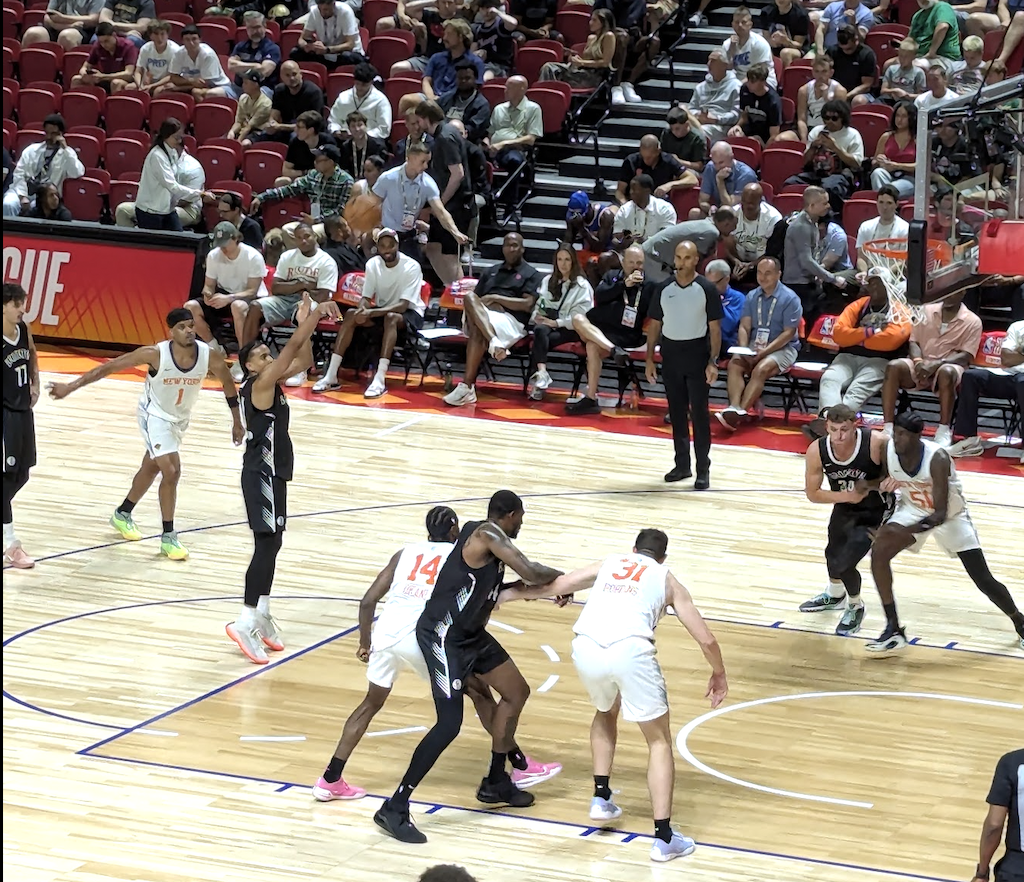
Before coming to Vegas, Acuff played in the California Classic in front of Kings fans. The former Arkansas Razorback looked like he had heavy legs. Fatigue may have a lot to do with his poor shooting percentages. He shot a dreadful 26% from behind the 3-point arc and 36% from the field in three games.
Brayden Burries, the Bucks’ first-round pick and 10th overall selection, lived up to expectations. The 6-4 guard played with poise and first-class pace. They were the same attributes he displayed in his one season at Arizona. He averaged 23.5 points per game, which was second-best at the Vegas summer league based on a minimum of four games.
Keaton Wagler and Kingston Flemings may have made some L.A. Clippers and Atlanta Hawks fans a bit nervous. Wagler, the No. 5 pick overall, put up decent scoring stats (18 points per game) in four games for the Clippers, but he seemed overwhelmed by the physicality. He’ll need to add more muscle to his thin frame. He also struggled bringing up the ball as the lead guard. He may have to play more off the ball next to natural point guard Darius Garland.
Flemings averaged just 7.0 points in two games and shot 33% from the field. The struggles that Flemings dealt with during March Madness resurfaced in summer league. The eighth overall pick needs to pick up the pace because he’ll be counted on to fill the Hawks’ starting point guard spot after the departure of Trae Young. Flemings did play for Kelvin Sampson at the University of Houston. So far, Houston Cougars guards have done well at the pro level.
These 3 rookies exceeded expectations
Cameron Carr — The former Baylor Bear looks like a first-round steal for the Lakers after an impressive summer. He looked comfortable playing on the ball as well as off the ball. He does need to add more weight to his 175-pound frame, but the high-end athleticism and pro-ready skills are evident. Carr is a natural scorer, with a smooth mid-range jumper. The 24th selection in the 2026 NBA draft flashed the type of 3-point shooting that could earn him a spot in JJ Redick’s regular rotation. His perimeter shooting and athleticism are exactly what the Lakers need to help create space for Luka Doncic and Austin Reaves. Carr averaged 18 points per game in Vegas, helping the Lakers win four of their first five games and earn a spot in the semifinals. The Lakers have whiffed on their last couple of first-round picks (Dalton Knecht in 2024 and Jalen Hood-Schifino in 2023), but Carr appears to be a home run. He’ll be a useful 3-and-D chess piece that Redick can use at his disposal.
Koa Peat—Peat has a frame NFL scouts love. He’s a 6-7, 235 physical specimen with solid footwork. Koa possesses a combination of size and strength that allows him to move defenders. His father, Todd Peat, played nine seasons in the NFL while his older brother, offensive lineman Andrus Peat, played for the New Orleans Saints and Pittsburgh Steelers. Koa was bigger than the average high school player, so he often overpowered opponents. His bully ball approach worked in high school and college, but some scouts didn’t think he’d be able to do it at the pro level. So far, Koa is proving some of the naysayers wrong, showing exceptional mobility for a 235-pound forward, and he moves a lot quicker than he looks. He’ll need to improve his face-up jumper and develop a perimeter shot beyond 15 feet, so he won’t feel the need to put his head down all the time.
Labaron Philon Jr. — Six years ago, the Philadelphia 76ers hit the jackpot when they selected Tyrese Maxey with the 21st overall selection. It turned out to be one of the best late-round picks. Maxey has turned into an All-NBA performer, and the Sixers have rewarded him with a $204 million max contract. Fast forward to this year, the Sixers may have found another late first-round gem in Philon Jr. The 6-4 guard from Alabama played with a chip on his shoulder and took every matchup personally. He showed up and showed out to let all the teams that passed on him know what they were missing.
Joel Huerto is editor and publisher of OneManFastBreak.net. He hosts a sports podcast on YouTube @onemanfastbreak1.